Test the soil before you buy the bag
Grass seed starting fertilizer is easy to throw in the cart next to a bag of seed, and it is just as easy to buy the wrong one. The economical sequence is slower and cheaper in the long run: test the soil, read the three numbers on the bag, and only then spend money on nutrients the new lawn actually lacks.
University of Minnesota Extension’s guide to fertilizing lawns is a clear official starting point, even if you do not garden in Minnesota. For a home lawn, nitrogen is usually the nutrient you think about most often. Phosphorus, the middle number on the bag, is already plentiful in many soils, and established lawns often show little response to more of it. Because phosphorus does not move easily in soil, Extension notes that extra amounts are often useful when you are establishing new turf — and then immediately adds the rule that should govern the purchase: only apply phosphorus if a soil test indicates a need.
That last sentence is the whole buying guide in miniature. A “starter” label is not a soil test. Some states and local authorities also restrict phosphorus on lawns. Check those rules where you live, and do not assume a national product display is legal or useful on your street.
All fertilizers, natural or manufactured, can contribute to pollution if you use them badly. Sweep what lands on the sidewalk back onto the lawn. Do not feed a storm drain.
How to read the bag without paying for numbers you do not need
The analysis on a fertilizer bag is a set of percentages by weight: nitrogen (N), phosphate (P₂O₅), and potash (K₂O). A bag marked 10-10-10 is not “stronger” in a vague sense than a bag marked 10-0-4. It is a different recipe. If your soil test says phosphorus is already adequate, the second ten is a nutrient you should not be adding, starter branding or not.
Nitrogen will still matter for a new lawn, but more is not automatically better, and a weed-and-feed or a crabgrass preventer mixed into the same bag can work against you. Many pre-emergent crabgrass products can also interfere with the grass seed you have just sown, and fertilizer-herbicide blends are often timed for a job that is not “new seed.” Read the label as if it were the law, because for pesticide-containing products it is. If the label does not allow use at seeding, leave that bag on the shelf.
Potassium may be needed on some soils, especially coarser, sandier ones, which is again a soil-test question, not a guess at the garden center.
| Buying question | A cheap, correct habit | An expensive habit | Official idea to keep in mind |
|---|---|---|---|
| Do I need a starter bag at all? | Get a soil test, then buy a fertilizer that matches the report | Grab any “starter” because the seed display is next to it | Apply phosphorus only if the test says you need it |
| What do the three numbers mean? | Match N, P, and K to the test and to the label rate | Pay for a high middle number as if it were insurance | The numbers are percentages of the bag, not a quality score |
| Can I use a weed-and-feed? | Usually, no, not as your seeding fertilizer | One bag that “does everything” | Herbicides and seedings are often a bad timing match; the label decides |
| How much should I buy? | Calculate the area, then the label rate, then the bags | A spare heavy bag “for later” that sits open in the garage | Over-application wastes money and can add to runoff |
| What happens after I spread it? | Follow the label on watering; keep product off hard surfaces | Leave granules in the gutter | Extension is blunt: material on pavements contributes to nutrient runoff |
| Organic or manufactured? | Compare actual nutrient amounts and cost per unit of nutrient | Assume “organic” means you can ignore the rate | Nutrient concentration is often lower in natural products, so you may need more product for the same nutrient |
If two bags could both match the test, buy the one you can spread evenly with the equipment you already own, at a rate you can actually calculate.
Measuring the lawn, then the rate
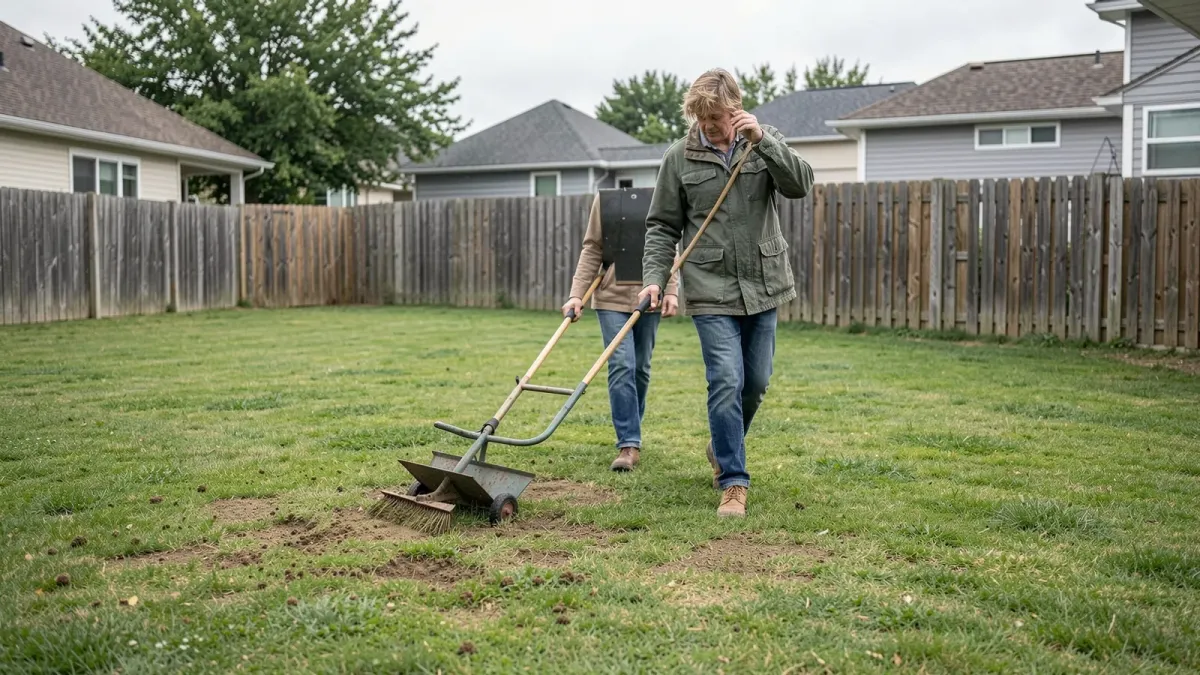
Walk the area with a tape or with long paces you have measured once on a driveway. Length times width, minus the patio, is enough. Write the square footage on the seed bag so you do not do this twice.
Then read the starter product’s rate for new lawns, if the label has one, and do the arithmetic before you open the spreader. A soil test from a university lab or another reputable service is worth more than a second impulse bag. Ask your local Cooperative Extension service where to send soil in your state; the UMN page above is a model of the kind of guidance they offer.
Water according to the label and according to the needs of new seed, which is a moisture question as much as a fertilizer question. A fast-release product applied heavily on a hot, dry day is a classic way to scorch a lawn you were trying to start. Extension’s lawn-fertilizer page describes that “burn” as nutrients pulling water from the plant when they are too concentrated around the roots. The cheap prevention is the right rate, the right day, and water when the label wants it.
If you are only overseeding thin spots, treat those spots as the project. There is no economy in feeding the whole yard with a starter recipe it does not need.
A buyer’s checklist you can take to the shop
- I know the square footage I am seeding
- I have a soil test, or I have a plan to get one before I add phosphorus
- The bag’s three numbers match that test
- The label allows use at seeding; it is not a crabgrass preventer or weed-and-feed used on a guess
- I can calculate the rate and shut the spreader off over hard surfaces
- I will sweep up granules that land on the pavement
- I have checked local phosphorus rules
Questions worth asking before the checkout
Do I always need starter fertilizer when I sow grass seed?
No. You need the nutrients the soil lacks, in the amounts the test and the label support. A starter product is a convenient way to supply those nutrients when the test says you need them, especially phosphorus on a new lawn. It is not a mandatory companion to every seed bag.
Why do some starter fertilizers have a lot of phosphorus?
Because phosphorus does not move easily in soil, and new roots may benefit when a test shows it is lacking. If the test does not show a need, that extra middle number is not a gift. In some places it may also be restricted.
Can I just use leftover lawn food from last summer?
Only if the analysis and the label fit a new seeding, and only if the product does not include a herbicide or pre-emergent you cannot use with seed. When in doubt, read the label and ask your extension office, rather than emptying a mystery bag “so it doesn’t go to waste” on the one planting that is hardest to repeat.
How soon should I fertilize again after the grass comes up?
Follow the product label and a local extension schedule for a new lawn, not a calendar copied from a different climate. Established-lawn rates are a different job. Do not stack a second heavy application because the first shoots look thin; thin shoots are often a water, seed-to-soil, or timing problem.